There is a running cultural joke across the internet: "Whatever you do, never turn on the Big Light." And while humorous, it exposes a genuine spatial truth. A single pendant fixture suspended dead in the middle of a compact room is an optical disaster. It pours unforgiving downward lumens onto the centre of your rug, creates harsh eye-level shadows under furniture, and lets the perimeter walls dissolve into gloomy obscurity.
Our brains assess the physical volume of an interior space not by how much light hits the floor, but by the luminance of vertical wall planes. When room corners are dark, our peripheral vision perceives the room boundaries as encroaching. Illuminating corners with soft, diffuse indirect light dissolves those sharp 90-degree junctions, creating an optical illusion that pushes the walls outward.
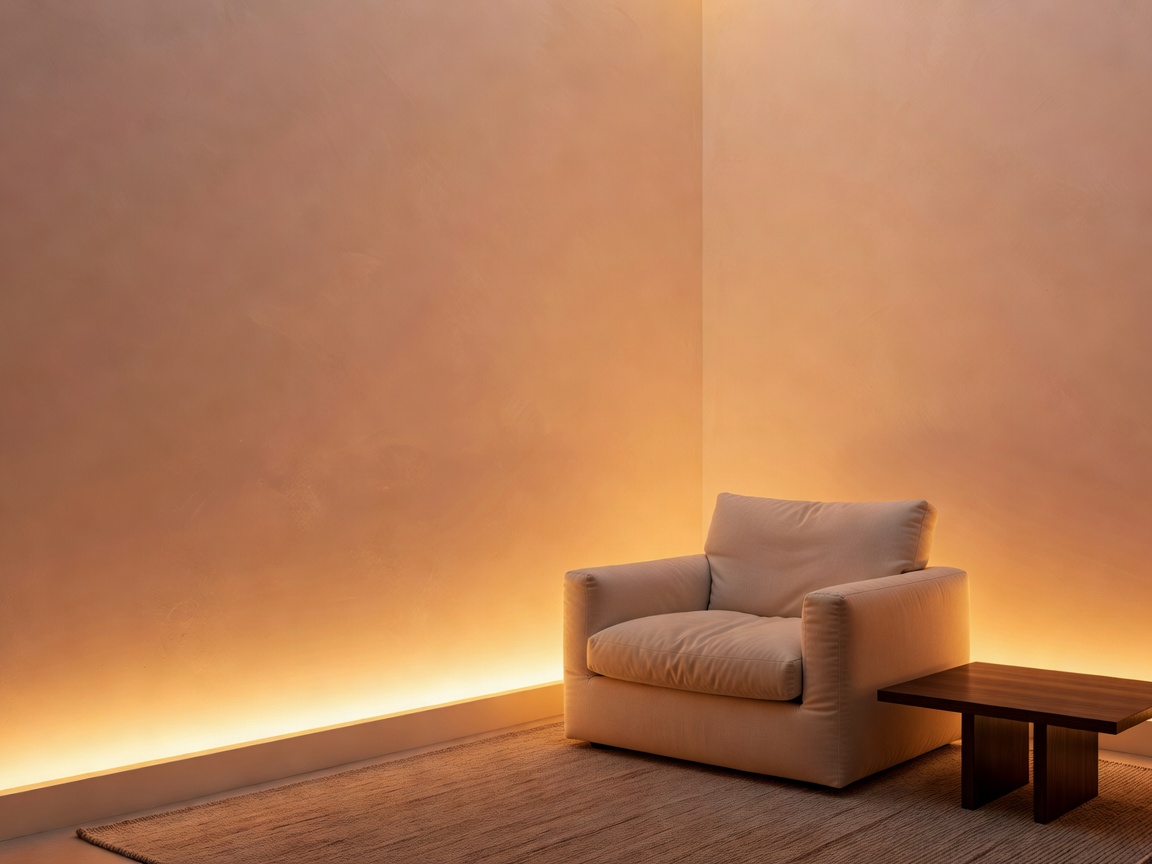
The Three-Layer Corner Illumination Formula
To achieve hotel-grade coziness without spending hundreds on designer fixtures, apply our three-tiered layering approach within your corner zones:
| Layer Level | Fixture Type | Kelvin (Color Temp) | Primary Purpose |
|---|---|---|---|
| Low (Floor level) | Floor canister can-uplight | 2200K – 2400K (Candle amber) | Washes wall up to eye height; anchors seating |
| Mid (110–140 cm) | Paper shade lamp or sconce | 2700K (Warm home glow) | Tactile focal point; gentle task lighting |
| High (Cornice level) | Concealed linear LED strip | 2700K – 3000K | Ceiling perimeter bounce; expands headroom |
Why Wall Texture and Finish Matter
When you aim light into a corner, your paint finish becomes part of the fixture itself. Gloss or semi-gloss paints reflect harsh specular hot-spots that irritate tired eyes.
Pros & Cons of Perimeter Corner Uplighting
Pros
- Zero visible glare: light source remains shielded from direct sightlines.
- Visually widens narrow rooms by pushing perceived perimeter outward.
- Encourages melatonin production and evening circadian wind-down.
Cons
- Highlights wall plaster imperfections if surfaces are not smooth.
- Requires smart plug adaptors or accessible floor switches to control comfortably.
- Not sufficient as solitary task lighting for detailed handcrafts or sewing.
Smart Automation: Sunset Syncing
The true magic of sensory corner lighting unfolds when it operates seamlessly in the background. By pairing your corner fixtures with basic Zigbee or Wi-Fi smart plugs calibrated to local astronomical sunset, your living space smoothly transitions from vibrant daytime workspace into an enveloping, amber-drenched relaxation lounge without you lifting a finger.